If you’ve been told you have sleep apnea, your first instinct might be to picture a bulky machine on your nightstand, a hose snaking across your pillow, and a mask strapped to your face every single night. For a lot of people, that image alone is enough to make them hesitant to pursue treatment. But here’s the good news: the CPAP machine is not your only option, and for many patients, it doesn’t even have to be the first choice.
At Serenity Valley Family Dentistry in Fargo, we take a whole-body approach to sleep apnea treatment, and that includes being genuinely open to whatever works best for you as an individual. Dr. Shandra Rosenfeldt has dedicated the majority of her clinical week to sleep, TMJ, and airway care, and our team understands that effective treatment isn’t one-size-fits-all. Whether you’ve tried CPAP and struggled, or you’re newly diagnosed and exploring your options, we’re here to help you find a path that actually fits your life.
What Is Oral Appliance Therapy?
Oral appliance therapy (OAT) involves wearing a custom-fitted device in your mouth while you sleep, similar in look and feel to a mouthguard or a retainer. The appliance works by gently repositioning your lower jaw and tongue forward, supporting your airway open throughout the night. It’s quiet, compact, and easy to travel with, and most patients find it significantly easier to adjust to than a CPAP machine.
The American Academy of Dental Sleep Medicine recommends oral appliance therapy as a front-line treatment for mild to moderate obstructive sleep apnea, and it’s also considered a valid alternative for patients with severe sleep apnea who are unable to tolerate CPAP. Devices are custom-made based on scans of your teeth, which means they fit precisely and work more effectively than over-the-counter alternatives you might find online.
How CPAP Works and Why Some Patients Struggle
CPAP, or continuous positive airway pressure, has long been considered the gold standard for treating obstructive sleep apnea. The machine delivers a continuous stream of pressurized air through a mask, physically blowing the airway open during sleep. When used consistently, it’s highly effective. But the challenge is consistency.
Studies suggest that a significant number of CPAP users don’t use their machines as often as recommended, and non-adherence is one of the most common barriers to successful sleep apnea treatment. Patients frequently report difficulty sleeping with the mask, skin irritation, feelings of claustrophobia, dryness or congestion, and general discomfort. For patients who travel often, the logistics of bringing a machine and distilled water can feel like a hassle. None of this means CPAP is a bad option, because for many people, it is a great one. It simply means that compliance matters, and if you’re not using your treatment, it isn’t working.
Comparing the Two Side by Side
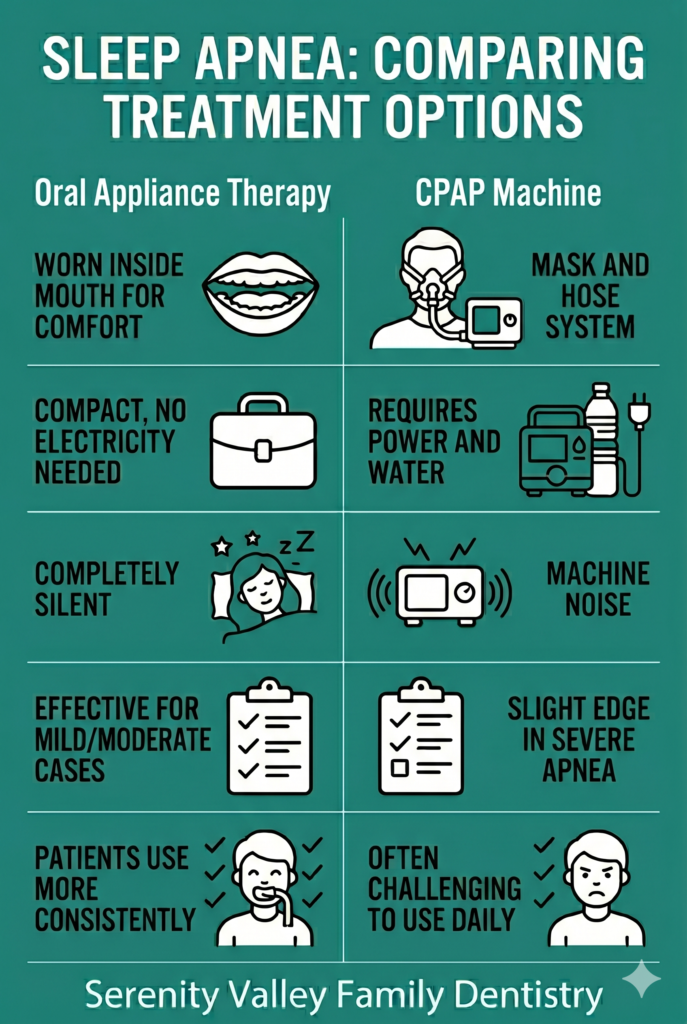
Both CPAP and oral appliance therapy aim to accomplish the same goal: keeping your airway open so your body can complete full, restful sleep cycles. Here’s how they differ in practice:
- Comfort: Oral appliances are worn entirely inside the mouth, making them far more natural to sleep with than a mask-and-hose system.
- Portability: Oral appliances fit in a small case and require no electricity, making them ideal for travel or camping trips.
- Noise: Oral appliances are completely silent, which is a welcome change for light sleepers and their partners.
- Effectiveness range: CPAP has a slight edge in treating severe sleep apnea, while oral appliances are highly effective for mild to moderate cases and serve as a strong alternative across all severity levels.
- Compliance: Research consistently shows that patients use oral appliances more consistently than CPAP, translating to better real-world outcomes for many people.
One thing worth knowing: the two treatments don’t have to be in competition. Some patients use both, tolerating their CPAP better or relying on their oral appliance for travel and the CPAP at home. Our team is completely open to supporting whatever combination genuinely helps you sleep better and breathe easier.
Who Is a Good Candidate for Oral Appliance Therapy?
Oral appliance therapy tends to be a great fit for patients with mild to moderate obstructive sleep apnea, as well as those who snore significantly. It’s also commonly recommended for CPAP-intolerant patients, people who travel frequently, and anyone who has found that the discomfort of CPAP is getting in the way of actually using it. Patients with TMJ concerns will want to discuss their jaw health before starting appliance therapy, and our team will always complete a thorough evaluation before recommending any treatment path.
It’s also worth noting that sleep apnea doesn’t only affect older, overweight men, a misconception Dr. Rosenfeldt hears often. Sleep apnea affects children, teenagers, women, and people of all body types. Symptoms don’t always include loud snoring or gasping; many patients simply feel chronically tired, experience increased anxiety or depression, or notice that they just can’t seem to feel rested, no matter how many hours they sleep. If any of that sounds familiar, it may be worth discussing your airway health.
Sleep Better with Serenity Valley Family Dentistry
Serenity Valley Family Dentistry has been serving families in the Fargo area since 2006, and our commitment has always been to meet patients where they are, with honesty, compassion, and the time to really listen. Dr. Rosenfeldt is a qualified member of the American Academy of Dental Sleep Medicine, and she devotes the majority of her clinical week to sleep dentistry, airway health, and TMJ care. We take the connection between sleep and oral health seriously and work collaboratively with sleep physicians and other local providers to ensure you receive a comprehensive, well-rounded plan.
If you’re ready to explore your options and finally get the rest you deserve, we’d love to talk with you. Reach out through our contact form to schedule a consultation with our team, and let’s find the sleep solution that’s right for you.