

You wake up, reach for your coffee, and immediately notice a dull ache in your jaw; one that definitely was not there when you went to bed. Sound familiar? Teeth grinding, known clinically as bruxism, is one of those sneaky habits that happens while you sleep, meaning most people have no idea they are doing it until the damage starts to show up in their daily life.
At Serenity Valley Family Dentistry in Fargo, ND, the team regularly sees and treats this. Founded in 2006, we take a whole-person approach to dental health, meaning we get to the root of what is driving your symptoms rather than just treating the surface-level effects. If you have been waking up with headaches or a tender jaw more mornings than not, keep reading.
How to Know If You Are Grinding Your Teeth at Night
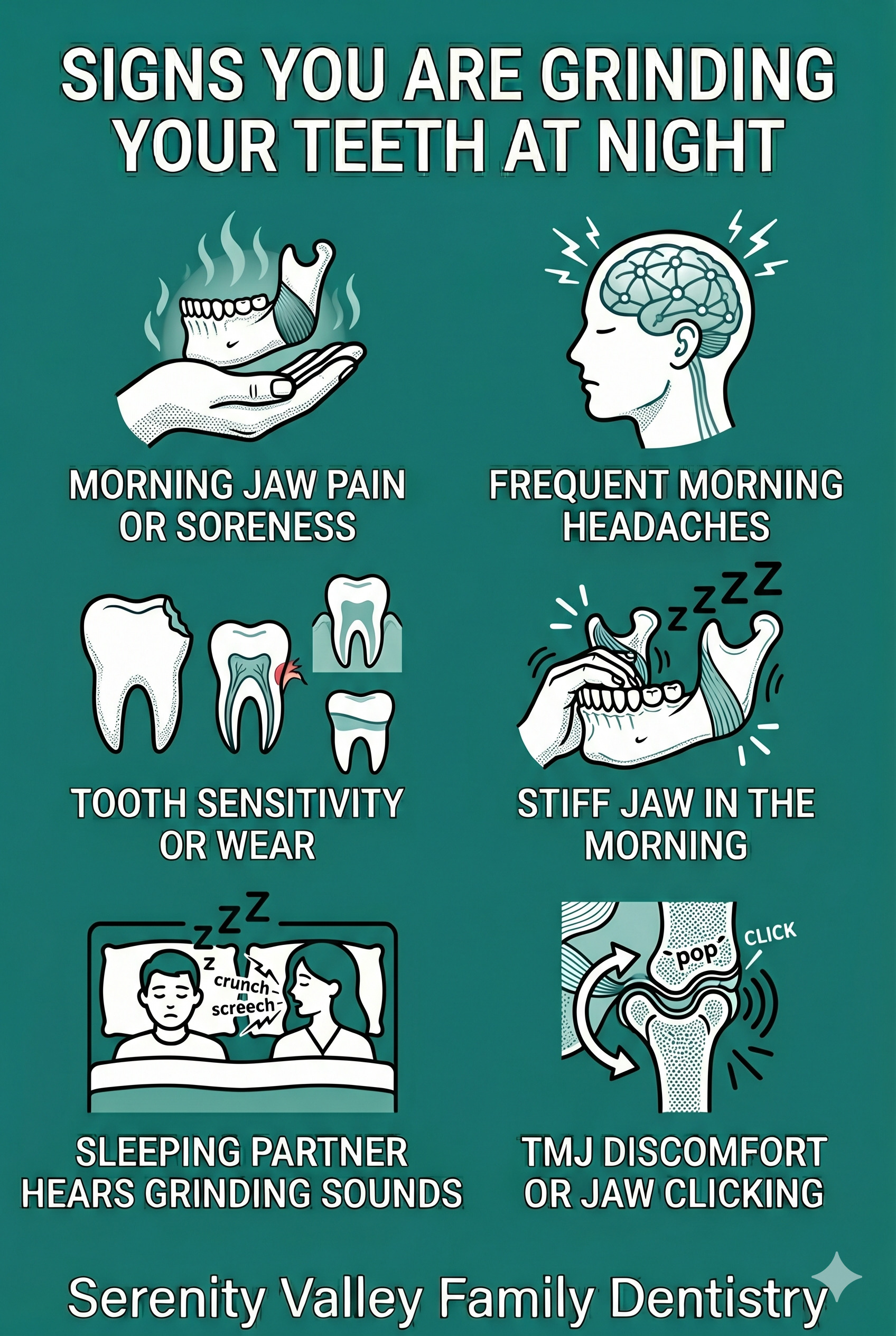
There are several telltale signs that bruxism may be disrupting your nights, and many of them show up long before you ever notice visible damage to your teeth. Here is what to watch for.
Morning Jaw Pain or Soreness
This is one of the most common red flags. When you clench or grind your teeth throughout the night, the muscles in your jaw are essentially working overtime for hours. The result? You wake up feeling like you just finished an intense workout, but only in your face. A sore or tired jaw that loosens up as the morning goes on is a strong indicator that bruxism may be at play.
Frequent Headaches, Especially in the Morning
Those persistent tension headaches that greet you before your alarm even goes off may not be from stress or dehydration alone. Nighttime grinding creates tremendous pressure across the jaw and skull, which can radiate into the temples and forehead. If you find yourself reaching for pain relievers before breakfast on a regular basis, it is worth paying attention.
Tooth Sensitivity or Wear
Grinding gradually wears down the enamel on your teeth, the hard protective outer layer that cannot grow back once it is gone. Over time, this can leave your teeth looking flatter or shorter than they used to, and you may notice them becoming more sensitive to hot, cold, or sweet foods. Chipped or cracked teeth with no obvious cause are another sign. These are issues that go beyond cosmetic, as worn enamel makes teeth far more vulnerable to decay and the need for restorative dentistry procedures down the road.
A Partner Who Tells You That You Sound Like a Coffee Grinder at Night
Okay, maybe they put it a little more diplomatically than that. But if someone who shares your space has mentioned hearing a grinding or clenching sound while you sleep, that is essentially a live witness account worth taking seriously.
TMJ Discomfort or Jaw Clicking
Bruxism and TMJ disorder symptoms often go hand in hand. The temporomandibular joint is the hinge connecting your jaw to your skull, and ongoing grinding can inflame and strain this joint over time. If you notice clicking, popping, or a limited range of motion when you open your mouth wide, bruxism may be a contributing factor. According to the National Institute of Dental and Craniofacial Research, TMJ disorders affect millions of Americans and are closely linked to habits like clenching and grinding.
What Causes Teeth Grinding?
Bruxism does not always have a single, tidy cause, and that is part of what makes it so easy to overlook. Several factors are commonly involved, and they often work together.
Stress and anxiety are among the most frequently cited triggers; tension that accumulates during the day has to go somewhere, and for many people, it ends up in the jaw at night. Sleep-disordered breathing is another major contributor. Research has shown a meaningful link between snoring, airway disruption, and oral health, and bruxism is frequently seen in people with undiagnosed sleep apnea. Bite misalignment and certain medications can also play a role.
What Can Be Done About Bruxism?
The good news is that bruxism is very treatable, and you do not have to just live with the morning soreness and worn-down teeth. Treatment typically starts with identifying what is actually driving the habit, because the right approach depends entirely on the cause.
Here is a quick overview of the most common solutions:
- Custom night guards are a first-line option for most patients. Unlike over-the-counter versions, a professionally fitted guard is designed to protect your teeth from the force of grinding while reducing muscle strain throughout the night.
- TMJ-focused care may be recommended if the joint has already been affected, including advanced options like photobiomodulation laser therapy.
- Sleep evaluation is often part of the conversation, especially when airway issues are suspected to be contributing factors.
- Stress management and physical therapy can also play an important supporting role in reducing the frequency and intensity of grinding episodes.
The key is getting a proper evaluation so the right combination of solutions can be put in place for your specific situation.
Serenity Valley Family Dentistry Is Here to Help You Get a More Restful Night’s Sleep
If any of the signs above hit a little close to home, you are not alone, and you are in the right place. At Serenity Valley Family Dentistry, Dr. Shandra Rosenfeldt and her team take the time to truly understand each patient’s situation before recommending a course of action. That whole-person approach has been at the heart of this practice since 2006, and it is something patients across the Fargo-Moorhead area count on.
Do not let bruxism quietly chip away at your smile and your sleep quality. Contact our office to schedule an evaluation and find out what is really going on with your jaw.